
Save Our Seneca Park Advocacy Campaign
In This Profile: Program Description • Program Goals • Timeframe • Funding/Support • Results Achieved • Lessons Learned • Ask The Expert • Contact Information
Introduction: The Landmark Society of Western New York is a not-for-profit membership organization dedicated to preserving, interpreting and fostering interest in the architectural, historical and cultural heritage of our nine-county region, centered on Rochester. Activities include operation of two house museums and a historic garden, educational programs, technical assistance, advocacy activities, book publication, and tours and other events. The Landmark Society is one of the central members of the Seneca Park Alliance, a coalition of neighborhood, environmental, and parks groups. The Landmark Society of Western New York is a member of the National Association for Olmsted Parks.
Program title: “Save Our Seneca Park” Advocacy Campaign
Program description: For over 20 years, the Landmark Society has been involved in efforts to protect Seneca Park, one of three large urban parks in Rochester designed by Frederick Law Olmsted in the 1890s. The main threat to the park has been the ongoing expansion of the Seneca Park Zoo.
Seneca Park is a linear, nearly 300-acre park located a few miles north of downtown Rochester. Its original design included lands on the east and west sides of the Genesee River, which in this area cuts through a dramatic gorge with steep wooded banks. For most of its length the park is quite narrow, consisting of little more than the steep river banks themselves. In the area known as the Lower Park, the park broadens across a flat tableland, where Olmsted designed a manmade pond, picnic groves, scenic loop drive, woodland paths, gorge overlooks and other distinctive landscape effects. This is the section of the park that best represents Olmsted’s original design intent, and remains highly intact today.
The Seneca Park Zoo began as a seasonal collection of small-scale enclosures for native animals, such as deer and birds, within the Lower Park. In the 1930s, a permanent menagerie building was constructed atop a natural ridge southeast of the Lower Park, in an area that, while within the park boundaries, was well screened by both topography and vegetation. The ridge on which the zoo is located is very narrow, and is wedged between a residential neighborhood, at a higher elevation to the east, and the rest of the park, at a lower elevation to the west. Expansion opportunities are extremely limited.
Aerial view of the Lower Park with Seneca Park Zoo in the foreground. Photo courtesy of Democrat and Chronicle.
In response to two efforts to dramatically expand the zoo into the Lower Park, the Landmark Society joined forces with other local organizations to advocate for the preservation of the historic park. The earlier campaign culminated with a park/zoo master planning process that incorporated the input of Olmsted experts and developed a successful compromise, allowing the zoo to expand within a reasonable boundary while protecting the core of the park.
In 2000, following the creation by the County (without the input of parks advocates or scholars) of a new zoo master plan that envisioned a 600-car parking lot in the heart of the Lower Park, the Landmark Society and several other groups joined together as the Seneca Park Alliance. This group used a variety of tactics, described in “Lessons Learned,” in its efforts to put a halt to this destructive plan.
After the immediate threat of the 2000 Plan abated, the Landmark Society and other core alliance groups focused their advocacy efforts on proactive measures to educate the public, and key public officials, about the value of the city’s Olmsted parks, in the belief that increased awareness of the parks’ historic and cultural significance will lead to better stewardship of these treasured resources.
Program goals/ issues addressed: The primary goal has been to ensure that the Seneca Park Zoo does not expand into core of the historic park. A significant issue that has been encountered repeatedly is the need to raise awareness, both among public officials and the general public, of the value of Rochester’s Olmsted park system.
Timeframe (planning/ execution): Intense advocacy efforts occur as needed; proactive educational efforts are ongoing.
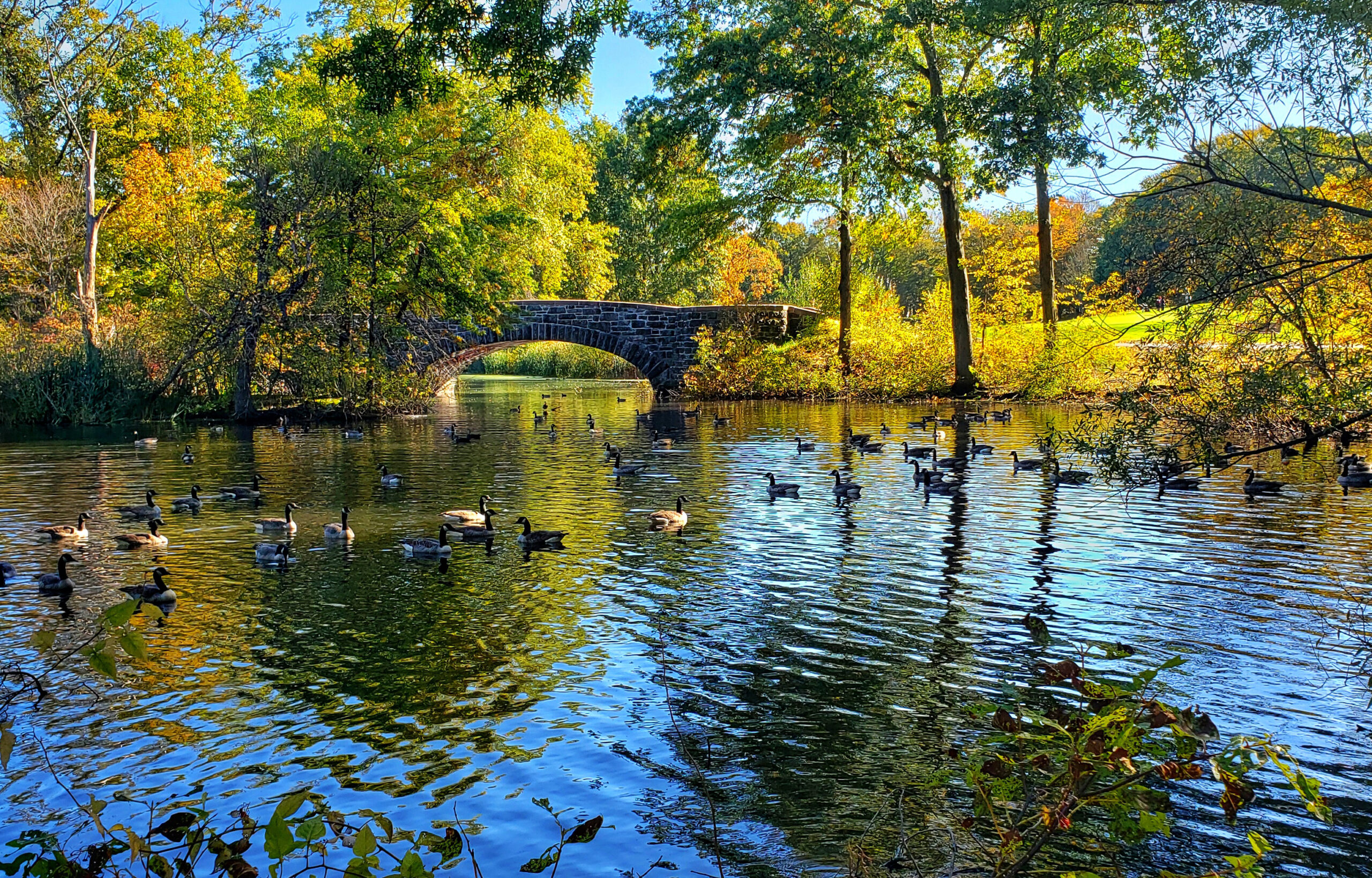
Trout Pond in the Lower Park.
Photo courtesy of Seneca Park Alliance.
Funding sources/ partnerships and type of support provided: Funds have been raised from direct appeals to Landmark Society and Seneca Park Alliance members.
Results achieved/ impact: It is impossible to quantify the results of these advocacy efforts, except to note that the most intrusive expansion plan was not (or has not yet been) implemented. Unfortunately, zoo expansion, albeit at a smaller scale, remains an issue, and the master plan calling for wholesale destruction of the park remains on the books as the operative plan for the zoo.
Lessons learned:
1) Demonstrate that park preservation has broad, credible support.
a. Establish a coalition representing various constituencies with similar positions on the issue; the more varied the coalition, the better.
i. The Landmark Society’s coalition included environmental, park advocacy and neighborhood groups, including a group representing a low-income neighborhood. This showed that the position had widespread support and countered the potential charge of “elitism.”
ii. Working together helped the various groups share knowledge and resources.
iii. Working together also allowed groups to coordinate their message and to have a single, credible and identifiable spokesperson (and avoid providing a platform for more extreme positions).
iv. Having the Landmark Society, an established organization with 501c3 status, as a lead player enabled the group to focus on advocacy instead of administrative start-up tasks, and also enabled the group to accept tax-deductible donations.
b. Support or propose an alternative plan.
i. At various times the Landmark Society/Seneca Park Alliance supported a more modest zoo expansion plan or proposed alternatives, such as shuttle parking, that would accommodate zoo improvements with minimal harm to the park.
ii. Positioning your organization “for” rather than only “against” something casts it in a more positive light and can show that your position is reasonable.
c. Take every available opportunity to provide spoken and written comments as part of the official public process.
i. While in this case, there was little hope of influencing the outcome via the normal public process, it was important to participate to establish a record of involvement.
ii. Spokespeople prepared detailed remarks, carefully crafted in advance, and never spoke “off the cuff” or emotionally.
iii. Spokespeople kept their message positive (supporting a different zoo expansion plan; opposing the unpopular parking lot without opposing the zoo itself) and professional.
d. Show, rather than tell, how broad the support is for the cause.
i. Lawn signs were used to demonstrate the geographic range of concern for the park.
ii. Avoid tactics such as petitions or disruptive demonstrations as these tend to be dismissed or get lost in a sea of similar efforts.
e. Work closely with the media.
i. Do the media’s work for them: create detailed press releases with pertinent contact information (and make sure someone can be reached easily to answer follow-up questions); hold press conferences to coincide with newsworthy events; provide as much information as possible.
ii. Find ways to use the media to advance your educational aims. For example, during a time when the zoo controversy was relatively quiet, an interested reporter who had been covering the topic in the local paper put together a major feature story about Olmsted and his role in Rochester.
Image courtesy of Democrat and Chronicle
2) Demonstrate the value of the park (historic, aesthetic, economic, etc.)
a. Bring in outside experts to educate the public and decision-makers.
i. The Landmark Society sponsored lectures by Olmsted experts, particularly in the 1980s; in addition to helping in the short term, this built a base of support that was critical later.
ii. Keep in mind that while Olmsted is well known within landscape/history/park fields, his name is not necessarily well-known outside those areas; to those outside those fields the phrase “Olmsted park” does not have the cachet it does to those who already value Olmsted parks, and will not be enough to stop an intrusive project.
iii. Most people are unfamiliar with historic landscapes and need to be educated as to why they are significant, how to see their design features, appropriate treatment.
b. Nominate park as a local landmark and to State and National Registers.
i. The Landmark Society obtained a determination that the park was eligible for the National Register in the 1980s; this is a simple process.
ii. Park advocates nominated the park for local landmark designation in 2003; normally local landmark designation has the “teeth” that can stop a destructive project.
iii. Landmark Society staff researched and wrote a National Register nomination for the park and Multiple Property Documentation Form for the entire Municipal Park System – a detailed, time-consuming, costly effort.
iv. Successful designation demonstrated that it wasn’t just the Landmark Society or unhappy neighbors claiming the park was historic, but that state and national experts agreed.
v. Would have been more effective if it had been done ahead of time rather than in the midst of controversy.
c. Offer public tours of the park.
d. Set up a Web site.
3) Demonstrate the true impact by using visuals and analogies (show, rather than tell).
a. Those promoting zoo expansion had flashy graphics to portray their project as exciting (but never showed the actual impact on the park); preservationists had to counter these with something more memorable and exciting than static landscape images.
b. Seneca Park Alliance staked out the area of a proposed parking lot with yellow police tape and held a press conference at that site.
c. Used a 17-foot tall banner at a press conference/rally held shortly before the County Legislature's vote on the 2000 Plan to show how much fill would need to be brought in to level the site. (Photo courtesy of Seneca Park Alliance)
d. Photographed a familiar 600-car parking lot to demonstrate the scale of the lot proposed for Lower Seneca Park.
e. Calculated the volume of fill that would be required to level the site for the parking and expressed it in recognizable terms – number of truckloads, size of a familiar building.
f. Mounted poster-sized photographs of the park to bring to public presentations, events, etc.
4) Try to prevent the implementation of the plan through political or legal means.
a. Historic preservation and environmental law did not protect the park in this case: could not bring in SHPO via Section 106 (no government funding or permits were to be used for zoo expansion) – but the knowledge that the project could not be approved under Section 106 may have limited the funding sources available to the county.
b. When approaching lawmakers, make the case as simply as possible, using visuals, figures and arguments tailored to their specific interests and constituencies.
c. Seneca Park Alliance ultimately sued the county on the grounds that its environmental review was flawed; lost original case and on appeal; this was an expensive, last-resort option that failed to kill the plan directly but may have contributed to the delays that ultimately prevented the plan’s implementation.
5) Think past the current controversy and toward the future.
a. Despite ongoing differences about the future of the zoo, the county and the Landmark Society found ways to work together on the common goal of promoting the Olmsted parks, creating the “Olmsted Task Force” in 2005 to work on projects such as tour brochures and interpretive signage; this keeps the Landmark Society at the table.
b. Ongoing advocacy efforts are focused on encouraging more appropriate zoo planning that takes park preservation into account.
c. Educational efforts must continue to raise awareness among decision makers and build strong support for park preservation.
A complete workbook on this case study will be issued in spring 2007.
Ask the Expert:
Name: Katie Eggers Comeau
Title: Preservation Advisor
E-mail:
This e-mail address is being protected from spambots. You need JavaScript enabled to view it
Date submitted: 11/03/2006